
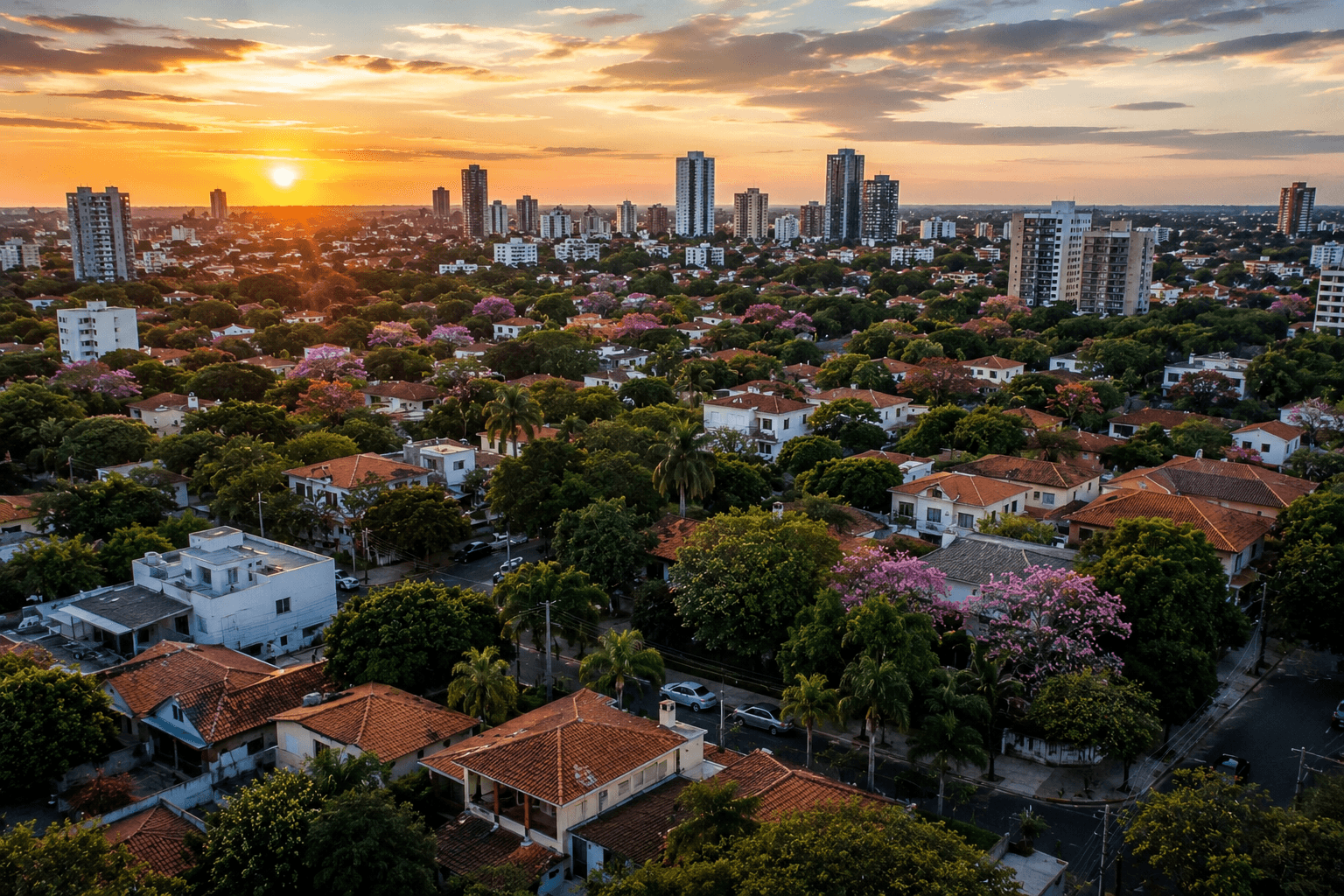
Is Paraguay a safe country for investment? That’s the question almost every French-speaking investor asks when discovering the country. Is it dangerous? What will happen to my money if the guaraní collapses? These are legitimate questions: a country you don’t know deserves to be thoroughly vetted, not just reassured.
Here are the five most common misconceptions we hear on this topic, along with the statistics that help debunk them.
1. «Paraguay is an unstable country»
This is the most common misconception—and the one least supported by recent data.
A reassuring credit rating
Two international credit rating agencies, Moody’s and S&P Global consider the country's debt to be safe for investors. Their ratings (Baa3 and BBB-, with a stable outlook) reflect a high level of confidence. This is higher than the confidence placed in Colombia, Morocco, or even Brazil.
Continuity in policy, not just in power
This confidence is not based on some abstract notion of stability. The Colorado Party has dominated Paraguayan politics since the 1940s. There was only one real break in this dominance between 2008 and 2013. What reassures the rating agencies, therefore, is not continuity in and of itself. Rather, it is what this party has been pursuing for decades: pro-investor, pro-business, and pro-property-owner policies. In other words, it is this continuity in economic policy—more than political stability in the broad sense—that makes the environment predictable.
A country that is catching up
The country is also landlocked, with no coastline, which has historically hindered its development. Its neighbors with access to the Atlantic have pulled ahead in the meantime. But it is precisely this lag that presents an opportunity today. Asunción remains two to three times cheaper than Bogotá, Santiago, Buenos Aires, or Panama City. The capital is only now entering its cycle of urban modernization. Most other South American capitals have already largely completed theirs.
A Rare Demographic Driver
Added to this is a rare demographic trend. With 2.4 children per woman, Paraguay remains above the replacement rate. Yet birth rates are declining almost everywhere else in the region. The population is projected to grow from 6.46 million to more than 9.5 million within 25 years. Record-breaking immigration (more than 40,000 residency applications per year) is also driving this growth. The establishment of foreign companies such as Unilever and Toyota is also contributing to this growth. It is therefore not just a population in need of housing. It is a young workforce and an economy that continues to generate wealth over the long term.
Real, but limited, vulnerabilities
However, the country still has real vulnerabilities that must be addressed rather than ignored. A largely informal labor market, as well as governance and anti-corruption efforts that still have room for improvement, remain areas of concern. These fundamentals mean that investing in Paraguay is a bet on a country that is catching up, not on a fragile one.
Sources: IMF, Central Bank of Paraguay (BCP), Moody’s, S&P Global, World Bank, UN (fertility rate).
2. «It’s not safe; there’s too much crime.»
When it comes to security, Latin America is often associated with countries like Brazil or Colombia. Paraguay, however, is nothing like that. According to the U.S. Department of State, the country is classified as «Level 1: Normal Precautions.» This is the lowest risk level on its scale. By comparison, France is classified as «Level 2: Increased Caution.».
In practice, crime in Paraguay is geographically very uneven. It is concentrated almost exclusively in a few border areas linked to cross-border trafficking. This is not the area of interest to investors. In Asunción, in neighborhoods such as Villa Morra, Recoleta, or Las Lomas, the crime affecting residents is overwhelmingly opportunistic—cell phone theft or pickpocketing, rather than violence.
Source: U.S. Department of State (Travel Advisory Levels, 2026).
3. «The guaraní is an unstable currency; I’m going to lose value.»
The guaraní is one of the most stable currencies in South America. In contrast, the Argentine peso has lost more than 90 % of its value in just a few years. The Brazilian real, too, remains subject to sharp fluctuations. The country has not experienced a major currency crisis since the 2000s. Prudent monetary policy and controlled inflation account for this stability.
Recently, the trend has even reversed. Between 2025 and 2026, the guarani appreciated by about 19 % against the dollar. It also gained about 15 % against the euro. The country’s investment-grade rating and attractive real interest rates explain this appreciation. A 12-month fluctuation offers no guarantee for the future—currencies move in both directions—but it directly contradicts the common misconception that the currency is fragile.
The real answer to this common misconception lies elsewhere, in any case. New real estate in Paraguay is sold, rented, and resold in dollars, not in guaranis. You buy in dollars, collect your rent in dollars, and resell in dollars. The stability of the guaraní therefore becomes secondary to the value of your capital.
The key consideration lies elsewhere. If you pay part of your local expenses in guaranis, exchange rate fluctuations may slightly affect your profit margin. This is a detail to factor into your profitability calculations, not a risk that calls into question the property’s value.
Sources: Trading Economics, Central Bank of Paraguay (BCP).
4. «As a foreigner, I don’t have the same rights.»
It’s actually the opposite. A foreigner can purchase real estate in Paraguay in their own name and become the 100 % owner. No local partner or Paraguayan residency is required. The purchase is made with a passport, and you can complete the entire process remotely. About 60 % of Aura Capital’s clients purchase without ever having visited the country. Video tours, electronic signatures or signatures by proxy, and documented follow-up at every step make this possible.
That doesn't mean there are no legal risks. The real thing to watch out for isn't your nationality. It's the reputation of the developer and the strength of the contract you sign. We cover this topic in detail on our page about Legal Certainty and Pitfalls to Avoid, and which begins with Choosing the Right Real Estate Developer.
Source: Paraguayan Law No. 117/91 on Investment and local contractual practice.
5. «The market is too small; I’ll never be able to resell it.»
A property’s liquidity doesn’t depend solely on the size of the market. It depends first and foremost on the price at which you purchased it. A property bought off-plan costs significantly less than the same property once it’s completed. This initial margin provides flexibility when reselling. It allows you to offer an attractive price to the next buyer while still realizing a capital gain. In fact, you’ve already captured most of the value associated with the construction. This margin thus benefits both parties to the transaction, not just the first buyer.
Conclusion: Yes, Paraguay is a safe country in which to invest
Backed by hard data, this is not a blind bet. The country has an investment-grade credit rating and some of the fastest economic growth in the region. Its security ranking is even better than France’s. Furthermore, its legal framework protects foreign investors just as it does domestic ones. The country still has significant room for improvement, particularly in the area of governance. But that is not the primary factor influencing the decision to invest.
Our support does not incur any additional fees for you: Aura Capital is compensated by the developer once the transaction is finalized. If you’d like to take a specific project further, Explore our opportunities or Schedule a call with our team.
The economic, security, and credit rating data cited in this article are subject to change over time; they are current as of the publication date and should be verified if you are reading this article several months after it was posted online.
FAQ
Should we believe the common misconceptions about investing in Paraguay?
No, most of them don't hold up against the official figures. Stability, security, currency, or the rights of foreigners: there is a factual response to every common misconception, as detailed earlier in this article.
Is Paraguay really a safe place to invest today?
Yes, based on the figures. The country has an investment-grade credit rating and one of the fastest growth rates in the region. In fact, the U.S. State Department ranks its crime rate lower than that of France. Finally, its legal framework protects foreigners just as it does nationals.
Is Paraguay a party to an international economic agreement?
Yes. Paraguay is a founding member of Mercosur, along with Brazil, Argentina, and Uruguay, and an observer to the Pacific Alliance.
Do I need a visa to invest in real estate in Paraguay?
No. Purchasing real estate does not require a visa or prior residency. The issue of residency is separate from that of investment and only arises if you wish to settle there.
Why are so many companies and residents moving to Paraguay?
Local tax policies and some of the lowest energy costs in the region—thanks to Itaipu—are attracting companies such as Unilever and Toyota. A pro-investor environment also plays a role, as does a record number of residency applications each year, particularly from Brazil and Argentina.



Join the Discussion